ML pipeline
The backend never trains or runs inference inline. It submits pipelines to ZenML and polls their state. The choice of ZenML as the orchestrator is recorded in the MLOps decision record. The services behind the pipeline (STAC, MinIO, MLflow, and ZenML) and their roles are listed in the Architecture overview.
Deployment architecture
These services run together on Kubernetes. The fAIr backend submits pipelines to ZenML and manages ONNX serving through Knative. STAC is the source of truth for dataset and model metadata, S3 stores artifacts, MLflow tracks experiments, and Postgres stores service state. How HOT runs this on open source over AWS is described in How HOT uses open source on AWS to power humanitarian AI.
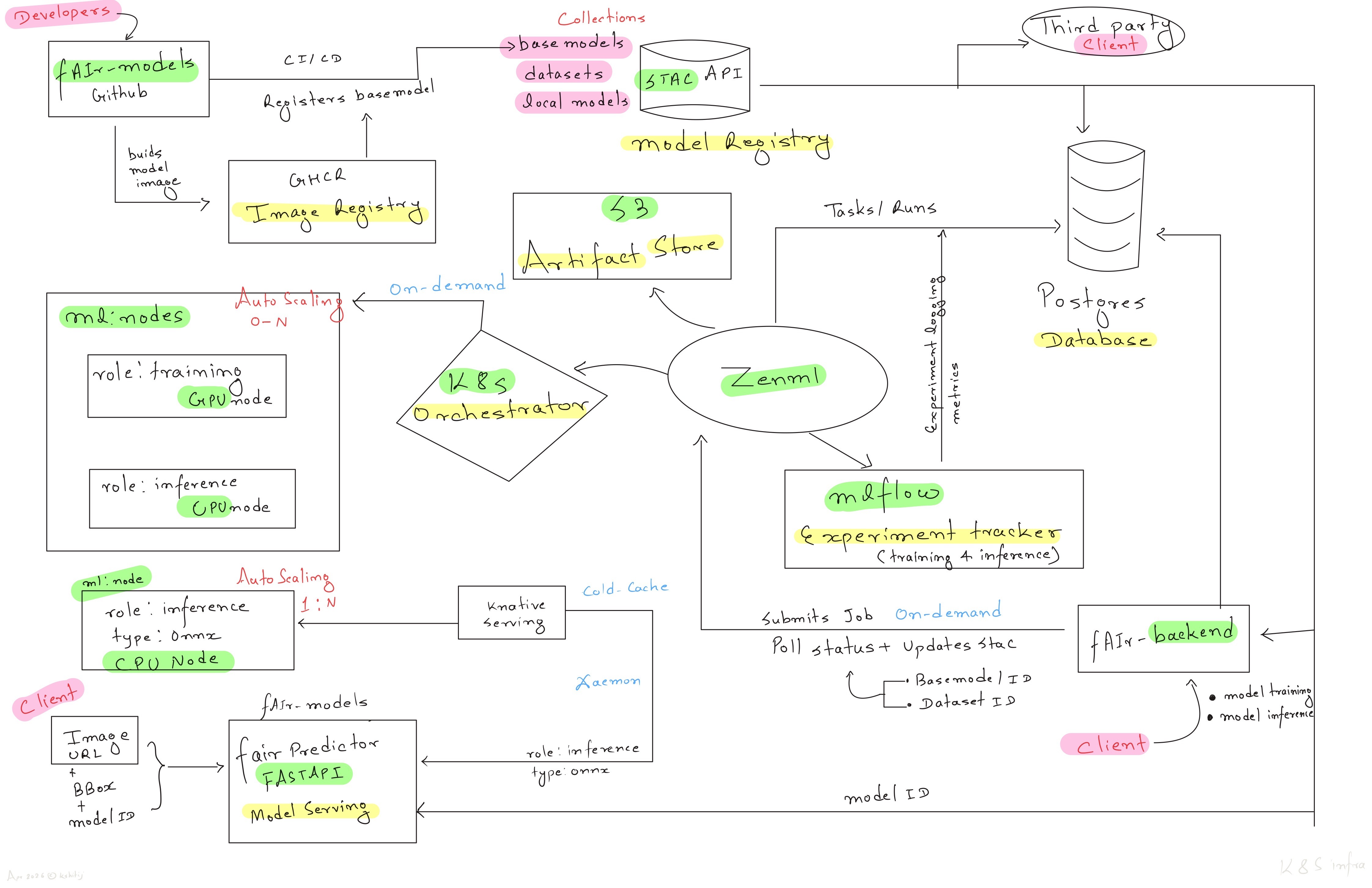
flowchart LR
    M[fAIr-models] -->|CI builds images| R[GHCR]
    A[Admin] -->|register pinned item| B[fAIr backend]
    R --> Z
    R --> K
    B --> S[(STAC)]
    B --> O[(S3 artifacts)]
    B --> P[(Postgres)]
    B --> K[Knative serving]
    B --> Z[ZenML]
    Z --> G[Autoscaling GPU jobs]
    Z --> O
    Z --> F[MLflow]
    K --> C[CPU inference]
Contribute and register a model
A model developer contributes through the fAIr-models catalog. CI validates the pull request and, after merge, publishes its training and inference images. An admin pins both image references to digests once and registers the same item in staging and production. Registration mirrors the weights into object storage and publishes the item to the environment's base-models collection.
flowchart TD
    A[Model developer] -->|Prepares PR| B[fAIr-models GitHub]
    B -->|CI: build, validate, test| C{Review}
    C -->|Merge| D[Publish training + inference images]
    D --> E[Admin pins image digests once]
    E -->|same item| F[Register and test in staging]
    F -->|approve| G[Register in production]
    G --> H[Production STAC + live Knative route]
Inside fAIr, registration is admin-only and asynchronous: the backend checks
that the pipeline module is bundled, then hands the STAC item to fair-py-ops.
It mirrors weights into a versioned artifact path, deploys a digest-pinned
inference revision, stamps the category into fair:category, publishes the
next integer STAC version, and marks the model active. Staging uses a tagged
Knative route without moving live traffic; production promotes the Ready
revision. The step-by-step API flow is in
Register a base model.
Local compose has no Knative
The inference-service deployment applies to the production Kubernetes setup. A local docker compose stack has no Knative, so that step is skipped.
The contribution diagram is adapted from the fAIr-models architecture docs.
Training
POST /trainings/submit/ returns 202 with a row whose zenml_run_id is null. A worker submits a ZenML pipeline that runs split, train, eval, and onnx, and polls status into the database. The run produces weights.pt and model.onnx in MinIO.
POST /trainings/{id}/publish/ is the only step that writes a versioned local-models/ STAC item. It validates the logged mlm:hyperparameters against the base model's fair:hyperparameters_spec.
flowchart LR
    A[submit] --> B[worker submits<br/>ZenML pipeline]
    B --> C[split -> train -> eval -> onnx]
    C --> D[weights.pt + model.onnx<br/>in MinIO]
D --> E[publish -> versioned<br/>local-model STAC item]Prediction
POST /predictions/submit/ enqueues inference. A worker downloads chips for the requested bbox, submits an inference pipeline, and a post-run step turns the GeoJSON into .fgb and .pmtiles. Only then is results_ready set, and GET /predictions/{id}/result/ returns three presigned URLs.
flowchart LR
    A[submit] --> B[worker downloads chips,<br/>runs inference]
    B --> C[post-run:<br/>geojson -> fgb + pmtiles]
    C --> D[results_ready = true]
    D --> E[GET result/<br/>geojson, fgb, pmtiles]